显示标签为“Rapid KL 快捷通”的博文。显示所有博文

2019年11月11日星期一

Seamless transfers now possible at Pasar Seni

Seamless transfers now possible at Pasar Seni


Walking between the Pasar Seni LRT/MRT stations and KTM's Kuala Lumpur station (as well as to the National Mosque) is now more straightforward with the new bridge across Klang River.

KUALA LUMPUR: Regular LRT, MRT and KTM Komuter users who need to make transfers at KL Sentral can do so seamlessly now at Pasar Seni.

A new 102m-long pedestrian bridge linking the Pasar Seni LRT station with the KTM Kuala Lumpur station opened on Friday after more than two years of construction.

The fully covered bridge is equipped with a bi-directional travelator which spans 50m.

This link also enables users to reach Masjid Negara and its vicinity such as Taman Tugu easily as it shortens the walking distance.

Work had commenced in April 2016 as part of requirements for the Sungai Buloh-Kajang (SBK) MRT line.

The Pasar Seni MRT station is already seamlessly integrated with the Pasar Seni LRT station.

However, crossing the Klang River to get to the KTM Kuala Lumpur station still proved to be arduous with users having to walk a long route via Menara Dayabumi.

Built by Mass Rapid Transit Corporation Sdn Bhd (MRT Corp) under the SBK line scope of works, the work was undertaken by MRT project delivery partner, MMC-Gamuda KVMRT (PDP) Sdn Bhd, with Trans Resources Corp Sdn Bhd as the main contractor for the bridge.

The scope of work included improvements to the Pasar Seni LRT station concourse, as well as the entrance to Menara Dayabumi nearby.

MRT Corp CEO Abdul Yazid Kassim hoped that the new bridge would encourage more to use public transport.

“Seamless connectivity is an important element in public transportation, and without it, people will lose interest in using the service, ” he said.

“The bridge is also designed in such a way that it will enable ticketing integration between the MRT/LRT systems with the Komuter system in future.

“We hope that this last mile barrier in terms of fare integration will be solved one day, ” he said.

The ownership, operation and maintenance of the bridge will fall under Prasarana Malaysia Bhd.

~The Star~

2019年7月10日星期三

Prasarana to manage Go KL City bus service in August

Prasarana to manage Go KL City bus service in August


(File pix) Prasarana Malaysia Berhad will now manage the Go KL City free bus service in the federal capital. Pix courtesy of Prasarana Malaysia Berhad

KUALA LUMPUR: Prasarana Malaysia Berhad (Prasarana) will now manage the Go KL City free bus service in the federal capital.

All the routes for the free bus service will be managed by Prasarana's subsidiary, Rapid Bus Sdn Bhd, and its service provider Rapid KL.

The one-year agreement with Dewan Bandaraya Kuala Lumpur, which will take effect on Aug 31 onwards, will see Rapid Bus managing six Go KL City bus routes. They are:

- KLCC - Bukit Bintang (Green Line);
- Pasar Seni - Bukit Bintang (Purple Line);
- Titiwangsa - Bukit Bintang (Blue Line);
- Titiwangsa - KL Sentral through Dataran Merdeka (Red Line);
- Titiwangsa - MINDEF (Orange Line); and,
- LRT Universiti - PPR Pantai Ria (Pink Line).

Prasarana Group chief operating officer (operations), Muhammad Nizam Alias said the company appreciated DBKL's trust in them to manage the six major routes and increase mobility in the federal capital.

“This is an important recognition for Rapid Bus Sdn Bhd and we will continue striving hard to provide the best service for our customers in line with our mission which is to provide world-class services for Malaysians,” said Nizam said in a statement.

The Go KL City bus service, launched on Aug 31, 2012, is a public bus service that offers free rides for commuters within the Kuala Lumpur Central Business District (CBD).

It is also aimed to reduce congestion in Kuala Lumpur by encouraging users to park their cars and use Go KL city bus service to travel around.

The stops encompass popular spots within the heart of Kuala Lumpur such as shopping havens, tourist attractions and prominent office towers.

The Go KL City bus service is equipped with free WiFi and designed to be disabled- and eco-friendly.

The bus service, which operates seven days a week, starts at 6am and ends at 11pm except for Fridays and Saturdays, where the service ends at 1am.

~News courtesy of New Straits Times~

2017年6月8日星期四

Sg Buloh-Kajang MRT fully operational by July 17

Sg Buloh-Kajang MRT fully operational by July 17

The Sungai Buloh-Kajang MRT line will be fully operational on July 17 with the completion of its second phase.

"MRT Phase 1 has been operational since Dec 16 last year, and Phase 2 will be operational this July, which completes the entire 51-km Sungai Buloh-Kajang line," said Prime Minister Datuk Seri Najib Tun Razak.

"I have already chosen a special date for the launch, which is July 17, or 17.7.17," Najib said in his speech at the launch of the Third National Physical Plan (RFN Ke-3), Second National Urban Policy (DPN2), and the National Rural Physical Planning Policy (DPF Desa Negara) here Thursday.

Najib said the MRT service will benefit over 500,000 commuters daily, and will help spur national productivity and growth.

"It is a necessity to implement an efficient public transportation system that will connect cities to towns and rural areas," he added.

~News courtesy of The Star~

2016年10月19日星期三

乘车落实综合付费系统 省时方便乘客纷赞

乘车落实综合付费系统 省时方便乘客纷赞


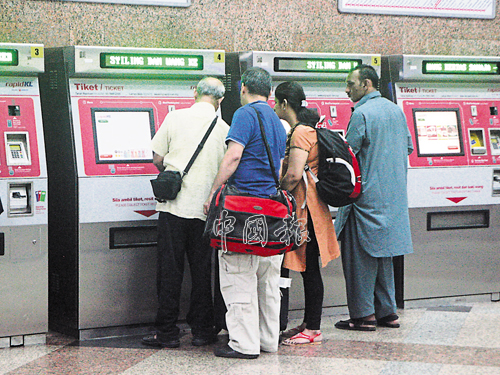
市面上的公共交通付费系统五花八门,不同付费方式可享不同等的折扣,民众纷纷为之混淆。

民众一致赞同落实综合付费系统,以拥有更便捷的乘车服务。


陆路公共交通委员会(SPAD)宣布,该会正研究一个公共交通付费系统(ICPS),并将和“一触即通卡”(Touch’n Go)合作,推出公共交通付费卡。


预计2018年落实的综合付费系统,陆路公共交通委员会将统一不同的公共交通收费系统,包括RapidKL收费,乘客也可使用新的提款卡或扣账卡在各个公共交通入口处付费,包括泊车转搭站。


《中国报》

2014年12月22日星期一

Monorail: Four-car trains make debut

Four-car trains make debut

The Rapid KL Monorail Line started putting the first two of its Malaysian-made four-car trains into service recently, marking a new era for the service.

Each of the four-car trains can accommodate 430 passengers per trip, compared with 213 passengers for the two-car trains.

Rapid KL Monorail Line chief operating officer Abdul Hadi Amran said Rapid Rail Sdn Bhd was happy to put the two trains into service as they could significantly reduce waiting time for passengers.

“With the doubling of the train capacity, we are able to take in more passengers at one time.

“Passengers need not wait for the next train. They can comfortably board the train now. With more four-car trains coming in next year, our service will be even better,” said Hadi who gave souvenirs to commuters to show appreciation for their support.

He said every car was equipped with four closed-circuit television cameras, newly-designed space for wheelchairs and strollers, and light-emitting diodes.

Hadi said two more four-car trains were scheduled to come into service by the first quarter of next year.

“The remaining eight will be deployed in stages. All 12 trains are scheduled to be in operation by the end of next year,” he said.

“Upon the delivery and commissioning of all 12 trains, the two-car trains, which have been in operational since 2003, will be decommissioned.”

Rapid Rail had also upgraded all its 11 stations, by installing universal access features and extending the stations’ platforms.

“We have also added a new wing at the Bukit Bintang station and an overhead bridge for direct access to KL Sentral Station from Nu Sentral,” he said.

Monorail has a daily ridership of about 65,000 and operates at 35 per cent overcapacity during peak hours.

Housewife Yusnani Yusoff, who was among the first to board the four-car trains, said: “Many people commute to Bukit Bintang every day and they need good transport. So, I am happy that we now have the four-car trains which are more spacious than the two-car trains.”

Marketing executive Nurul Nadia Abdul Hamid, 27, said, previously, she would give the ride a miss, especially during peak hours.

“The train can be too crowded with people heading to work, but now we do not have to wait for the next train as the four-car train can take more people at one go. I think more people will use monorail, especially on weekends,” she said, adding that she couldn’t wait for all the four-car trains to be fully operational.

College student Anissa Rifadiien from Jakarta said she was delighted to see the four-car trains.

“This new train is more spacious and more comfortable. We like it,” said Anissa who was travelling with her friends.

Her sentiments were echoed by Lim Eng Hwa, 62, who uses the monorail from the KL Sentral station to Titiwangsa, every Saturday.

“The new train is way better and more comfortable for the passengers.

“This will definitely encourage more people to use public transport while travelling around the city,” he said. By Nor Ain Mohamed Radhi


Each four-car train can accommodate 430 passengers.

~News courtesy of New Straits Times~

2014年4月5日星期六

单轨火车12日起暂停服务 巴士代步只需1元

单轨火车12日起暂停服务 巴士代步只需1元


吉隆坡单轨火车停止服务期间, 民众受促乘搭衔接巴士抵达目的地。左起麦克、莫哈末哈茲南、阿都哈迪及莫哈末艾森麦克。

吉隆坡单轨火车将于4月12日及13日(周末)暂停服务,以进行改善信息系统,受影响乘客受促使用衔接巴士服务(Shuttle Bus)作为替代方案。

吉隆坡单轨火车首席营运员阿都哈迪指出,这项信息系统改善工程,是为了准备迎来吉隆坡单轨火车4节车厢列车。

他说,工程会从12日午夜12时01分进行至14日凌晨4时,为时52小时,并预计于4月14日(星期一)凌晨6时恢复运作。

期间,乘客可以选择使用接驳巴士服务代步,收费一人只需1令吉,至于拥有特权卡的乐龄人士、残疾人士及学生更可享有半价优惠,即50仙。

他解释,由于必须要在没有干扰下进行信息系统测试的工作,因此该公司决定关闭单轨火车服务52小时,并希望乘客体谅。

“吉隆坡单轨火车4节车厢列车必须使用新的信息系统,而且该系统改善后能提供更先进及更准确的信息,包括控制车速和加强安全措施。”

他补充,新的4节车厢单轨火车列车,共有12辆,预计在今年第三季(8月)试跑,明年第二季正式全面投入运作。

巴士15分钟一趟

RapidKL首席营运员拿督莫哈末哈茲南强调,衔接巴士服务非常准时,乘客无须担心会延误抵达目的地。

“衔接巴士服务共有3条服务线及15辆巴士提供服务,巴士约15分钟来一趟,每日凌晨6时开始服务,每趟巴士不超过45分钟。”

哈茲南指出,该3条服务线分别是从吉隆坡中央车站———武吉免登车站、武吉免登车站———蒂蒂旺莎车站以及蒂蒂旺莎车站———吉隆坡中央车站,涵盖所有单轨火车车站的路线。

公众若有疑问,可浏览http://www.myrapid.com.my、快捷通(RapidKL)面子书或推特handler@MyRapidKL,以获取详情。

出席者有吉隆坡单轨火车扩充项目负责人莫哈末艾森及项目工程师麦克。

~南洋商报~

2012年10月6日星期六

New bus terminal

New bus terminal


All public bus operations at Medan Pasar terminal will be transferred to a new terminal at Lebuh Ampang near HSBC building from Oct 7. For details, call 03-7885 2585 from 7am until 8.30pm(weekdays) and 8.30am until 5.30pm (weekends) or visit www.rapidkl.com.my

~News courtesy of The Star~

2011年6月15日星期三

推行自动售检票系统‧rapidKL“一票”通

推行自动售检票系统‧rapidKL“一票”通

“自动售检票系统”除了有卡之外,还有“代币”供单程乘客使用。 (图:星洲日报)

rapidKL推行“自动售检票系统”,让乘客“一票”在手,就能顺畅抵达目的地!

国家基建公司集团执行总监沙立尔莫达表示,该提升工程耗资1亿1千520万令吉,乘客无需购买不同的车票,仅需使用““自动售检票系统”(Automatic Fare Collection)就可

现有系统11月杪停用

他指出,现有的票务系统将在11月30日停止使用,乘客在新系统下,可通过网上购票或添值服务,不过该系统仅完成62%,须待全面完成后才可使用

“该项服务可让乘客在使用该公司旗下的三个主要线路,即格拉那再也线、安邦线及单轨火车;该科技是源自于西班牙科技,提升工程则由Indra-Iris AFC公司负责。”

明年可达50万乘客量

另一方面,沙立尔莫达表示,目前这系统已安装在加百乐花园站、阿都拉胡贡站、苏丹依斯迈站和武吉加里尔站,预计该系统将在7月中旬正式启用。

他说,现有的系统陈旧不已,许多零件很难寻找,所以才采用最新科技代替。

“目前每天的乘客量大约是40万人,预计明年可达到50万乘客量,该服务也将在2013年延伸至电动火车和巴士服务,而格拉那再也延伸线路或将采用这项新系统,让更多人受惠。”

他相信,该项服务可为公司提高约10至15%的盈利。

针对敦依斯迈花园居民在早前反对兴建捷运站一事,他表示,一切有待证实,他将会在稍后公布这消息。

系统7月中旬试跑

该工程负责人阿都哈密表示,“自动售检票系统”将在今年7月中旬试跑,并在9月于上述4个站进行为期3个月的实用期。

“若一切顺利,我们预计将在12月开始正式启用这项新服务。”

他亦表示,新服务将有两种形式的票务,除了“自动售检票系统”外,还有适合单程乘客使用的代币。

出席者包括国家基建有限公司的设备集团总监诺哈山。

(星洲日报/大都会)
http://mykampung.sinchew.com.my/node/145332?tid=6